Front metallization is a trade between shading and resistance. The published answer is topology optimization, and both a gradient method (the method of moving asymptotes) and a learned generator are reported to beat a conventional finger grid. We began there and asked whether agentic discovery could push them further. It could not, yet, and the reason is the first result.
The constraint that decides the comparison
A metallization design has to be built, which puts three limits on it. Every metal feature must be at least as wide as the printer can lay down. The design must be metal or not metal. And every finger must connect to the busbar, because metal that connects to nothing carries no current and still blocks light.
Neither published method applies any of the three, so the reported number belongs to a continuous density field rather than to a layout. Measured from the released figures, the minimum feature of both published designs is one element. Most of each design is three to four elements wide, so the problem is the branch tips and the ends of the fingers. Even so, 3.1% of the metal in the published learned-generator design and 7.3% in the published gradient design sit outside any three-element feature and would not print.
We apply all three when a design is scored. Every design here goes through the same procedure: binarize the field, delete metal that does not reach the contact, widen what remains to the three-element minimum, then solve. Anything that cannot be repaired is rejected, and the rejection rule was itself checked against cases with a known answer, so that it neither passes a bad design nor discards a good one.
One thing this is not, yet. During the search the length scale is still a density filter of radius 1.5 elements, so the optimization does not itself carry the three-element rule; the rule arrives when the design is scored. Making the density field carry it, so that both arms search under identical constraints, is the first thing the next revision owes.
The published comparison uses designs that cannot be printed, and applying the printing limit reverses its ranking.
We reproduced the reference setup at the same cell, grid, filter radius and constants. Gradient descent gives 12.9645 against a published 12.9178, which is within 0.05. The network gives 12.6257 against a published 12.9217, which is 0.30 low. Neither number survives the constraints: repairing the designs costs gradient descent 0.66 points and raises its metal from 4.69% to 12.24%.
Under that requirement a conventional finger grid beats both, on less than half the metal of one of them.
| Design | As drawn | Printable | Metal |
|---|---|---|---|
| Reference, gradient descent | 12.9178 | not enforced | n/a |
| Reference, learned generator | 12.9217 | not enforced | n/a |
| This work, gradient descent | 12.9645 | 12.3035 | 12.24% |
| This work, learned generator | 12.6257 | 12.4868 | 6.51% |
| Conventional finger grid | n/a | 13.1686 | 5.43% |
Read the first column and the optimizers win. Read the second, the only column a factory can use, and the conventional grid beats both. Not because the repair was harsh: the grid meets the same rule with no metal outside a three-element feature.
An optimizer can succeed while the design gets worse
Whenever the quantity an optimizer improves is not the quantity the design will finally be judged on, the two are free to move in opposite directions, and nothing in the run reports that they have. The report measures this on the binarization schedule: four schedules, the SIMP exponent held fixed or ramped, each with and without a Heaviside projection. Ranked on the objective each optimizer reports for itself, they differ by more than eight points and a clear winner appears. Ranked on whether the design can be printed, three agree within 0.21 and 0.011 and the fourth returns nothing.
| Schedule | Gradient descent | Learned generator |
|---|---|---|
| Exponent 3, no projection | 12.3035 | 12.4868 |
| Exponent 3, then projection | 12.2745 | 12.4982 |
| Exponent ramped, no projection | 12.4881 | 12.4982 |
| Exponent ramped, then projection | none | none |
A comparison made on the wrong quantity would have looked confident and been wrong.
Strong conventional designs that are not obvious
The printable optimum turned out to be a conventional design, so the next question was how good conventional designs can be. Agents proposed families in text with a physical argument for each; we implemented, swept and scored them across four contact geometries. One of the families is ours rather than the system's: we added the symmetric comb after the sweep returned only lopsided designs on a symmetric contact.
Several of the strongest conventional designs are ones you would not reason your way to.
On the 1.5 cm cell the second and third best designs are centre-rooted trees, on a contact that runs the whole edge where routing is already free and nothing recommends that shape. On the 6 cm edge a symmetric comb beats the plain grid by 0.0496, so the classical construction has the shape right and the proportions wrong. And the best full-edge design in this sweep is a finger grid at a pitch the closed-form expression does not give: 10.9458 on 15% metal against the classical grid's 10.7914 on 18%.
What selects between the families is the contact, which is the one choice the published formulation holds fixed. Adding a vertical spine to the best finger grid costs 0.1141 points on a full-edge busbar and gains 9.7603 on a centre pad, where the same grid without a spine scores 0.0653 because most of its metal reaches no contact at all.
Hold the contact area fixed at 64 square millimetres, so that shading is constant, and vary only how far it reaches along one edge: printable efficiency climbs from 9.3538% at a 2.1 mm reach to 10.7524% at 60 mm, and to 10.7952% for a busbar registered along the whole edge. The span is 1.44 points, and the metal falls across it rather than rising. Set that against what searching bought on the same geometry. Seven structural families, three searchers, a multiscale ladder and a basin-hopping campaign moved the corner number by less than 0.05 points in total. Moving the contact 8 mm further along the edge moved it by 0.20.
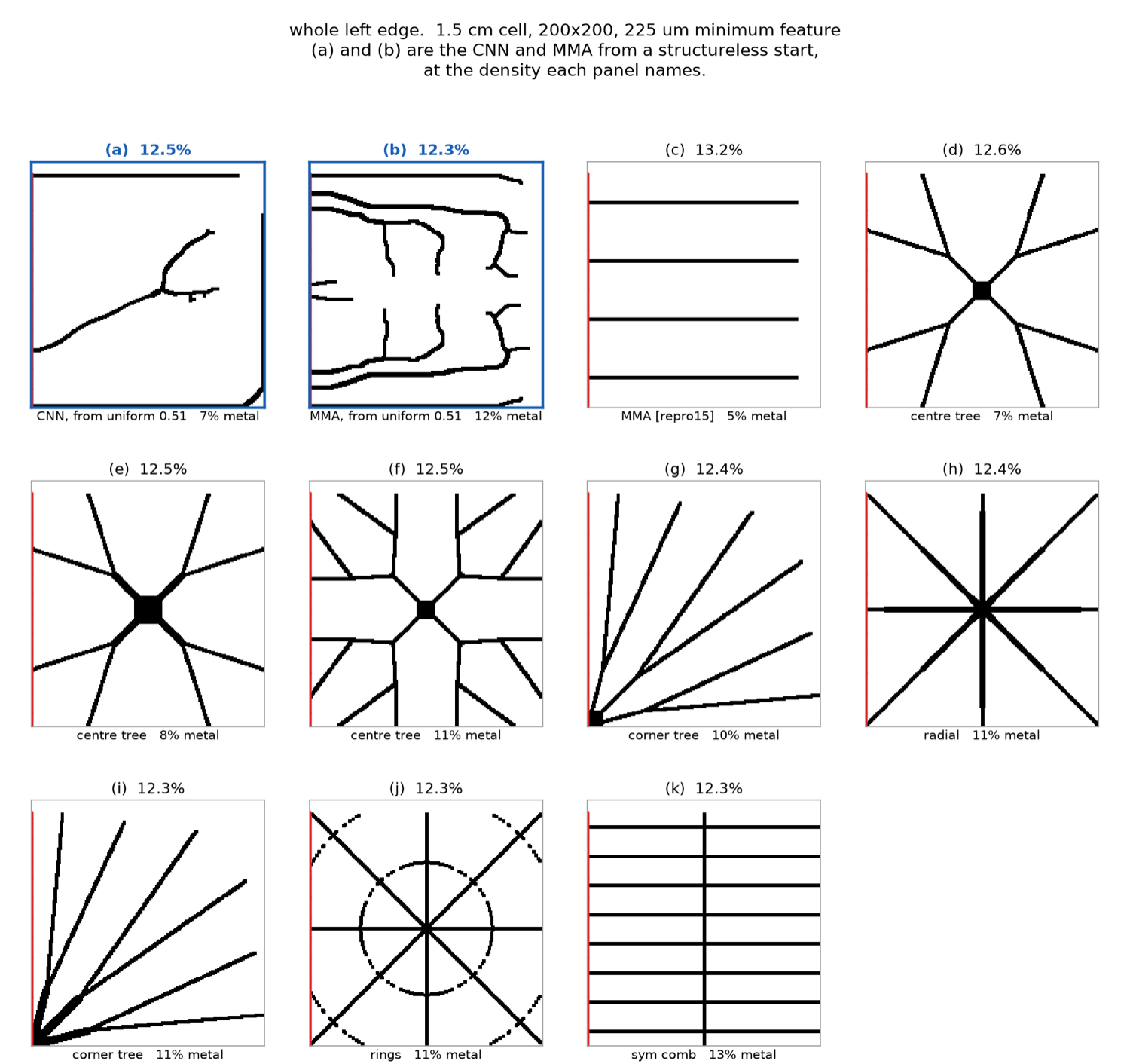
Started from a structureless field, neither optimizer reaches the best conventional design on any of the four geometries; the better of the two falls short by 0.6723 points at best and 1.2264 at worst. Seeded from the reproduced published design instead, gradient descent lands on the finger grid to four decimals at 13.1686 and the network stops 0.0041 short. Either way that is a reproduction, not an improvement.
What is actually scarce
A perfect collector, no shading and no resistive drop, would give 14.4080%. With no metal at all the cell gives 3.8047%. So metal has 10.6033 points to win, and the conventional grid already takes 88.3% of them. Of what is left, only 0.3978 points is resistive loss that better routing could recover, and it has to be taken without adding metal, because each extra 1% of metal costs about 0.15 points of shading.
Gradient descent shows what ignoring that costs. On the published cell it achieves the lowest resistive loss of any design in this work and still finishes last, because it bought that conduction with more than twice the metal.
What has run, and what has not
Agents propose formulations, families and hypotheses in words, with a mechanism and a falsifier attached to each. Classical optimizers do the numerical search. Agents are barred by construction from the numeric inner loop: an agent can propose a formulation; it cannot run the search. That is an architectural commitment rather than something this report measures, because the loop it describes has not run end to end.
Hypothesis generation has run. Two rounds produced 111 proposals; together with earlier work, the released register holds 126. Not one was a bare method name. The sharpest identified a mechanism we had missed: the optical loss is a pure area integral, exactly linear in metal area, so on a pixel field with a one-element minimum feature it is quantized in steps of one element area.
The generation also produced a result pointing the other way, and it is the more useful one. In each round, 27% of proposals supplied a screening test that would have rejected their own hypothesis, because the test was cheap along the very axis the mechanism depended on. A different detector caught it in each round. It is not obvious on reading, either: a human reviewer would plausibly approve most of them.
The rest of the loop has not run. No language model proposed a formulation to the optimization engine, and no experiment reported here was selected by one without a person in the loop. Screening was by argument rather than against the evaluator. No design in the report was produced or selected by a model.
What this does not establish
- A single-diode model on a uniform mesh, fixed constants, fixed busbar voltage. Nothing here has been validated against a fabricated cell.
- Absolute efficiencies read to one decimal: a 1% change in the diode parameter moves them by 0.18, more than several of the differences discussed. Comparisons are made at identical parameters, and only orderings that survive 10% perturbations are reported as orderings.
- Every result assumes uniform illumination, the regime most favourable to the feature-based parameterization.
- Single runs, no seed replication, no error bars. A companion measurement outside this revision showed the generator arm spreading about 0.37 points across weight initializations, so smaller differences are not yet claims.
- The minimum feature is three elements, 225 µm on this mesh. That is coarse against a modern screen-printed finger, so it is a mesh-derived floor, not a process one.
- The negative result covers the configurations searched, which the report lists. It is not a proof that no configuration exists. The reference designs were measured from released figures rather than arrays, so their feature statistics carry an uncertainty of about one element.
Where this goes
We are not arguing that these methods cannot beat conventional designs. We think they can. The remaining target is about 0.4 points, it has to be won without adding metal, and the obstacle looks like the representation rather than the optimizer. The next revision owes non-uniform illumination, a formulation that lets the density field carry the minimum-feature constraint, replication across seeds, and a screening stage that runs against the evaluator instead of against an argument.
If you work on a problem where evaluation is expensive and the framing is a judgment call, we would like to hear about it.
Work on one with us