Discovery where it matters, on the problems of today.
We work where an answer can still be checked. A design that either prints or does not. A model an interpreter either accepts or rejects. That is a choice, not a fallback: a discovery system nobody can check is a claim rather than a result. Every problem settled here is what earns the right to a harder one.
Four domains, one shape.
Evaluation is expensive, so the framing gets settled once and then inherited. And the rule that decides whether an answer is usable arrives after the search rather than inside it. Each of these is checkable, which is why they are first. We have a result in one, and we would take on any of the others with someone who lives in the domain.
Metal on a solar cell
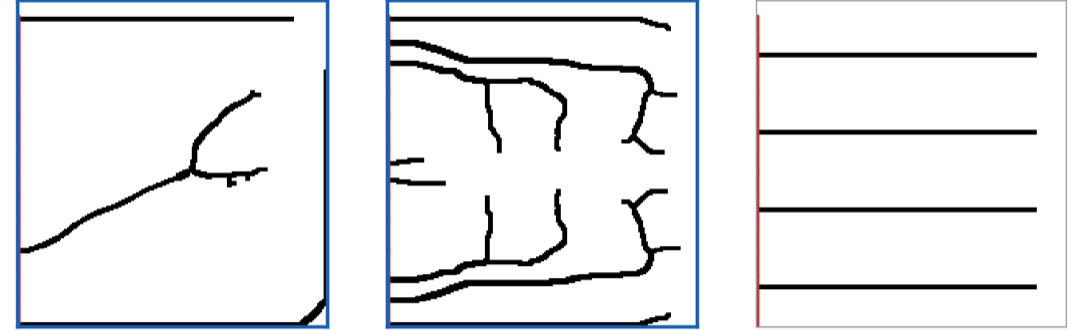
ActiveFront metallization trades shading against resistance, and the published answer is topology optimization. It is scored on designs nobody can print: no minimum width, no binary field, no connectivity rule. Score every design as it would actually be printed and the ranking turns over. A conventional finger grid beats both optimizers, on 5.43% metal against 12.24%.
How much of a published result survives the constraint that decides whether it can be built?
Structure that has to be built and certified
OpenTopology optimization is compared on compliance at a prescribed volume fraction, in linear elasticity, with manufacturability restored afterwards in CAD. The part that flies is minimum mass at non-negative margins on stress, buckling and fatigue. The giga-voxel wing study spent days on eight thousand cores for an estimated 2 to 5% saving, which is inside the error of what it held fixed.
If the length scale came from the process rather than from the mesh, would the same layouts still win?
Inverse problems in the subsurface
OpenOne gradient in full waveform inversion is a forward and an adjoint solve for every source, and a production run is a GPU cluster for weeks. It buys one attempt, not a comparison, so the misfit, the starting model and the frequency schedule are inherited whole. Cycle skipping is a property of that misfit's shape, not of the optimizer. Geological admissibility is judged at the end, by an interpreter who was never in the loop.
Of the starting model, the anisotropy fields and the misfit, which one decides the delivered depth?
Dose in a radiotherapy plan
OpenThe objective is a weighted sum of dose penalties whose weights a planner turns by hand until the plan looks acceptable. The template keeps the numbers and nothing of what was traded against what. Meanwhile the search runs on a fast approximate dose calculation while the plan is accepted on a slower and more accurate one.
If the planner's weights are the real formulation, what would it take to search them rather than tune them?
What we have put on the record.
We publish work in progress, including the parts that went against us. Each report says what has run and what has not.
A problem of today has one advantage.
Somebody can tell you whether you got it right. A design prints or it does not. A model ties the wells or it does not. Open-ended questions are where the field would like to be working, and they are also where a discovery system can be wrong for years without anyone noticing. Starting where the answer is checkable is not a smaller ambition. It is what makes discovery something you can demonstrate rather than assert.
So we build in that order deliberately: each problem settled under real constraints leaves the machinery able to take on a harder one, and leaves a record of why it should be trusted with it.